Fixed Air Conditioning & Ventilation

Fixed Air Conditioning & Ventilation

Nearly all air conditioning applications can be divided in to two sections: Comfort and Process.

Comfort Applications:
Comfort applications aim to provide an indoor environment that will be comfortable for the people occupying the building and will remain relatively constant, despite changes in external weather conditions or internal heat loads.

Process Applications:
Process applications aim to provide a suitable environment for a process being carried out, regardless of internal heat, humidity loads or external weather conditions. Although the temperatures maintained are often similar to comfort applications, it is the requirements of the process that determine conditions, not human preference. Examples of process applications include:

  • Comms Rooms
  • Electrical Switch Rooms
  • Laboratories
Unit Types
Maintenance Contracts/Service:
Installation
Ventilation

Citycool supply, install, maintain and service ALL air conditioning and climate control systems from a single small high wall split system to Air Handling Units and water chillers, nationwide.

Fixed Air conditioning units come in several shapes and sizes, designed to suit any application:

Climate Control

This term is used to describe the automatic setting of temperature where the climate control system provides either cooling or heating automatically to reach a previously set temperature. The air conditioning system will keep the room at that set temperature.

Hot aisle / Cold Aisle server rack server layouts were conceived as a strategy for a more energy efficient cooling of a data centre. In this type of server room layout, each successive aisle is designated either a hot aisle or a cold aisle. In cold aisles the server racks are aligned so equipment inlets are facing each other on opposite sides. In the next aisle, both banks of server racks exhaust hot air.

Typically, cool air form the Air conditioning system flows in to the cold aisle, allowing the cold air to easily reach the server inlets at the front of the racks, flow through the IT equipment and exhaust into the hot aisle.

This method should increase energy efficiency by allowing for higher temperature set points by directing cooler air closer to the equipment inlets. By concentrating the cool air where it is needed most, the air conditioning units can run a few degrees higher than would other wise be necessary.

A recent study by the American Environmental Protection agency has identified indoor air quality as one of the top five urgent environmental risks to public health. The problem of indoor air pollution is largely avoidable through the implementation of sufficient ventilation, yet many of us continue to ignore the seriousness of the issue. We only seem to take notice when visible structural problems such as moisture and damp arise or when the health of the buildings occupants is seriously threatened.

It is hardly surprising that, as a people who spend up to 90% of our time indoors Irish people are almost constantly exposed to some form of indoor pollutant. Naturally occurring pollutants such as dust mites, fungus and mould thrive in Ireland, and rapidly occur when there is dampness in a structure and a relative humidity of or in excess of 70%. Something as essential as breathing and everyday functions such as cooking, bathing, dishwashing, and drying of clothes can create up to 5kg of moisture per day independently adding to an already humid indoor environment.

Health problem such as eye and throat allergies, asthma, headaches, tiredness, coughing, wheezing and even mental confusion can result from cases of high humidity. These problems are also triggered by unventilated residue, emanating from pets, dusty window coverings, bed linen, cigarette smoke and pollen. Further more, chemical sources of indoor pollution, as can be found in many building materials, paints, varnishes, electronic equipment, photocopiers and printers, cleaning fluids and polishes commonly cause head aches, breathing problems and allergies.

The impact of poor ventilation on a structure is likely to cause considerable damage over time, leading to problems such as excessive moisture, damp stains, smoke stains on structural surfaces build up of dirt, condensation and deterioration of décor. Though the results of some of these problems may initially seem only superficially detrimental, the long term effects can cause serious problems. It is costly to repair damage caused directly as a result of poor ventilation an dit can be dangerous to leave the problem untreated. Structures under the pressures of poor ventilation are prone to weakening and can prove unsafe as surfaces eventually rot and dilapidate.

The benefits of seeking advice from experts cannot be understated given the various criteria buildings are obliged to fill. In this regard, the most efficient and effective ventilation system, to suit the needs of a particular building, should be installed. It is also important to keep timber floors well ventilated, as this will prevent dampness and reduce energy consumption caused by irregular air flow. Loft ventilation and ventilation of appliances is also essential. Loft ventilation serves to diminish moisture build up in the ceiling while ventilation of appliances prevents the release of dangerous gases into the habitable environment.

The current building regulations for ventilation stresses the main functions of a ventilation system on a general level should: “provide an adequate supply of fresh air for using an area or building; achieve occasional rapid ventilation for dilution of pollutants and of moisture likely to produce condensation in habitable rooms, kitchens and room containing sanitary appliances; and extract moisture form areas such as kitchens and bathrooms, where it is produced in significant quantities.

In contrast to typical extract systems, mechanical supply systems work to deliver ventilation through the release of air taken from an uninhabited area of a structur. These systems are often used n existing buildings that suffer form condensation and are low in power usage, which ultimately makes these systems effective and energy efficient.

Finally mechanical ventilation systems with heat recovery (MHVR) differ from the other mechanical systems in that they are able to reclaim heat that would other wise be lost through the ventilation. MHVR’s take the heat from “wet” room and supply it to “dry” rooms. They control humidity and can be installed as a system for an entire building or instead as individual room units. MHVR’s are extremely effective, especially during winter months.

It is essential that the consumer talks to an expert prior to the installation of a system, in order to make the most of the system and conserve energy. Good ventilation is a fundamental requirement for a building to be fit for occupation and can play a vital role in securing the health of its occupants, the structure and ultimately the value of the building.

Ventilation Guidelines

Air flow rate: This is the air flow volume required to be extracted or supplied in to a room during a given period of time.

There are several ways to calculate the required air flow:

  1. Calculate the volume of the room.
  2. Multiply this by the number of air changes per hour (ACH) see tables below. The answer to this will give you the air flow required in metres cubed/hr (m³h)

Industrial Applications ACH
Welding areas 15-30
Laundries 30-60
Boiler rooms 20-30
Engine rooms 20-30
Factories and work shops 6
Foundries 30-60
Stores and warehouses 3-6
Paint shops 30-60
Dye works 10-15
Electroplasting shops 10-15
Commercial Applications ACH
Assembly rooms 4-8
Banks 3-4
Bakeries 20-30
Cafes 10-12
Canteens 5-10
Cinemas and Theatres 5-8
Conference and Board rooms 8-12
Dance Halls 6-8
Garages 6-8
Gymnasium 6-12
Hair dressing salons 10-15
Hospital sterilising wards 4-6
Commercial kitchens 15-30
Laboratories 8-12
Launderettes 15-30
Lavatories 8-15
Libraries 3-5
Offices 4-8
Photo and x ray darkrooms 10-15
Recording studios 10-12
Restaurants 6-10
Schoolrooms 2-4

All these values must not take the place of any regulation requirements and can be modified for each particular application. 

Citycool have a full-time specialist installation team kited out to supply and install a broad range of equipment from the smallest portable air conditioning unit to the largest chiller, including commercial fridges, VRF systems and standard splits air conditioning systems.

We maintain a high level of control during all installations so we only use fulltime Citycool staff and not sub contractors.

Installations start at the planning stage, be it with the customer themselves, the engineer, architect, designer or M+E consultant. Before each installation we have a specific method statement and works schedule prepared and checked with the customer.

We can schedule works to ensure the minimum amount of disruption to the customer and the existing workings o the building. Whenever a disruption to a buildings workings is unavoidable, this work will be completed at a time suited to the customer.

When installation is completed a commissioning sheet is drawn up and signed by both customer and Citycool Engineer. The Citycool engineer will then explain the workings of the system and set the controls up for the customers particular requirements. Manuals are left with the customer for general use.

Types of Air Conditioning units

Citycool supply, install, maintain and service ALL air conditioning and climate control systems from a single small high wall split system to Air Handling Units and water chillers, nationwide.

Fixed Air conditioning units come in several shapes and sizes, designed to suit any application:

Ceiling Cassette Units

This type of air conditioning unit is ideal for commercial premises where floor and wall space is at a premium. Cooling and heating capacities range from 5kw up to 15kw. These air conditioning units are very quiet in operation and are designed to be mounted flush with suspended ceilings. Controls are normally wall mounted control panels. The cassette is square in shape and has supply grilles on each of the four sides. This ensures even conditioned air distribution. This makes the ceiling cassette ideal for open plan offices and large areas.

Compact Ceiling Cassette Units

Similar to standard ceiling cassette units except the compact body of the indoor unit fits in a 600x600mm common ceiling panel – directly replacing a standard ceiling tile.

Under Ceiling Units

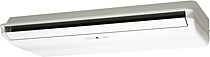
The under ceiling unit hangs under the ceiling and unlike the ceiling cassette the hole body of the unit is visible. The conditioned air is supplied via a single grille at the front on the unit. The Under Ceiling unit can circulate the air 6m from the grille. This feature makes the Under ceiling unit ideal for long narrow offices and retail units, IT Server rooms or especially applications where there is a limited ceiling void./span>

Ducted or Hideaway Units

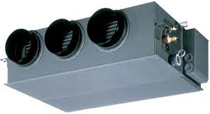
These air conditioning units are ideal for offices, studios or retail outlets where air distribution is beyond the reach of the standard type of split unit. The ducted air conditioning unit is usually hidden from view in ceiling void or attic. A network of air distribution ducts can be connected to the unit which can then supply conditioned air to several rooms at the same time. Air distribution grilles are connected to each duct and ensure uniform temperature distribution in large or heavily partitioned areas.

Floor Mounted Units

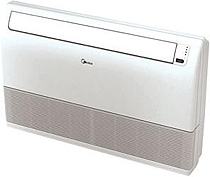
The indoor unit can be mounted at low level on a wall. Suitable as a direct replacement for a radiator or for refurbishment projects and small spaces with its compact space saving design.

Read More

Wall Mounted Monobloc AC Units

These are wall mounted cooling and / or heating air conditioning units, without the need for an outdoor condenser.

Beautifully finished wall mounted indoor (either high wall or low wall) provides:

  • Heating
  • Cooling
  • Dehumidifying
  • Fresh air ventilation
Read More

High Wall Mounted Units

These air conditioning units are mounted on brackets and fixed to the wall, generally close to the ceiling. High wall units are available in cooling and heating capacities from 2kw-11kw. They are ideal conditioning small offices, retail outlets and IT Server rooms.

AHU’s

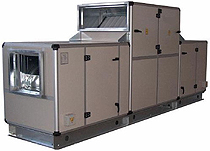
An Air Handling Unit or Air Handler is a device that is used to circulate and condition air as part of a HVAC system. (Heating, Ventilation and Air-conditioning). An air handler is a large metal box, which contains a fan, heating and/or cooling coils, filters, dampers and sound attenuators. Air handlers are usually connected to a ducting system which will distribute the conditioned air around the building and then a percentage of it back to the air handling unit.

Climate Control

This term is used to describe the automatic setting of temperature where the climate control system provides either cooling or heating automatically to reach a previously set temperature. The air conditioning system will keep the room at that set temperature.

Rapid Calculation of Cooling Requirement

You need approx. 50 watts of cooling power per cubic metre of room space. For a room with a cubic capacity of 87cubic metres, you would calculate the cooling requirement accordingly:

  • 87³m x 50 watts = 4,350 watts of cooling required (4.3kw)This is just a rule of thumb calculation. For a precise calculation of your particular application, please contact our office and we would be happy to conduct a free site survey.

Energy Saving Tips

Reduce your energy usage, your utility bills and your carbon emissions by following the guidelines listed below:

  1. Shop Around. Make sure your energy supplier offers the best value. Prices for gas and electricity can vary by up to 10%.
  2. Ensure that your building insulation is surveyed properly and that meets the required standard.
  3. Make sure all your electrical and mechanical equipment is regularly maintained. Blocked filters, coils will reduce operating efficiency by a minimum of 20%.
  4. Review your utility usage requirements on a regular basis.


100% of gas bills are for heating and cooling. 40% of electricity bills are for heating and cooling. If you can keep the hours of usage to a minimum and reduce temperature settings by even one degree it will decrease your costs.

  • Do not have your toilet extraction fans on 24/4. Set them up to run only when there is a demand for extraction.
  • Discourage staff from using a personal heater.
  • Encourage staff to close window blinds on hot, sunny days to reduce sun exposure and therefore reduce the energy required for cooling the work space.
  • Encourage staff to open blinds during a cold but sunny day in order to reduce heating requirements.

What Our Customers Say

City Cool exceeded my expectations! I needed a reliable air conditioning unit for my office, and their team guided me to the perfect solution. The installation was quick, and the system works flawlessly. Highly recommended!

Michael R.

Fantastic service from start to finish! We upgraded our home heating system with City Cool, and the difference is incredible. Our house is warmer, and our energy bills have even gone down. Couldn't be happier!

Sarah L.

City Cool is my go-to for ventilation solutions. They helped us install a high-quality system in our restaurant, and the air quality has never been better. Professional, friendly, and knowledgeable—great company to work with!

James P.

Absolutely top-notch service! City Cool installed a new air conditioning system in our home, and it's been a game-changer. The team was professional, efficient, and ensured everything was perfect before leaving. I highly recommend them!

Emma D.

Get in touch today to get a quote.

We’d love to hear from you

Head Office Phone: (+353) 41 9814981
Head Office Fax: (+353) 41 9814982
Mobile Phone:    (+353) 86 600 6447
Email: info@citycool.ie